How to Find Your Bank's IFSC Code: 4 Easy Methods
Imagine this: you are mid-transaction, transferring ₹75,000 via RTGS to a supplier in Pune, and the bank portal flashes a red error — "Invalid beneficiary IFSC." You pause. You are certain you copied it correctly from an old WhatsApp message. You were wrong. The branch merged three years ago, the code changed, and now your payment is delayed.
This is not a hypothetical. It happens every day across India's 181,000+ active bank branches.
Understanding what is ifsc code of bank infrastructure — and knowing exactly where to find a verified, current code — is one of the most practical financial skills an individual or business owner can develop. This guide covers every legitimate method, from physical documents to digital portals, ranked by speed and reliability.
What Is IFSC Code of Bank? A Working Definition
The Indian Financial System Code (IFSC) is an 11-character alphanumeric identifier mandated by the Reserve Bank of India (RBI). It is the digital postal address for every bank branch participating in electronic funds transfer — NEFT, RTGS, and IMPS.
The structure is straightforward:
- Characters 1–4: Bank code (e.g.,
SBINfor State Bank of India,HDFCfor HDFC Bank,ICICfor ICICI Bank) - Character 5: Always the digit
0— reserved by RBI for future scalability - Characters 6–11: Branch-specific code assigned by the bank
Without a valid IFSC, India's payment infrastructure — which processes over ₹30 lakh crore in NEFT transactions every month — simply cannot route your money. The system will reject it at the gateway level before it ever reaches a human reviewer.
Method 1: Your Cheque Book and Passbook (Fastest Offline Method)
If you have your bank's physical documents within reach, this is the most reliable method because the code is printed directly from the bank's own records.
On a Cheque Leaf
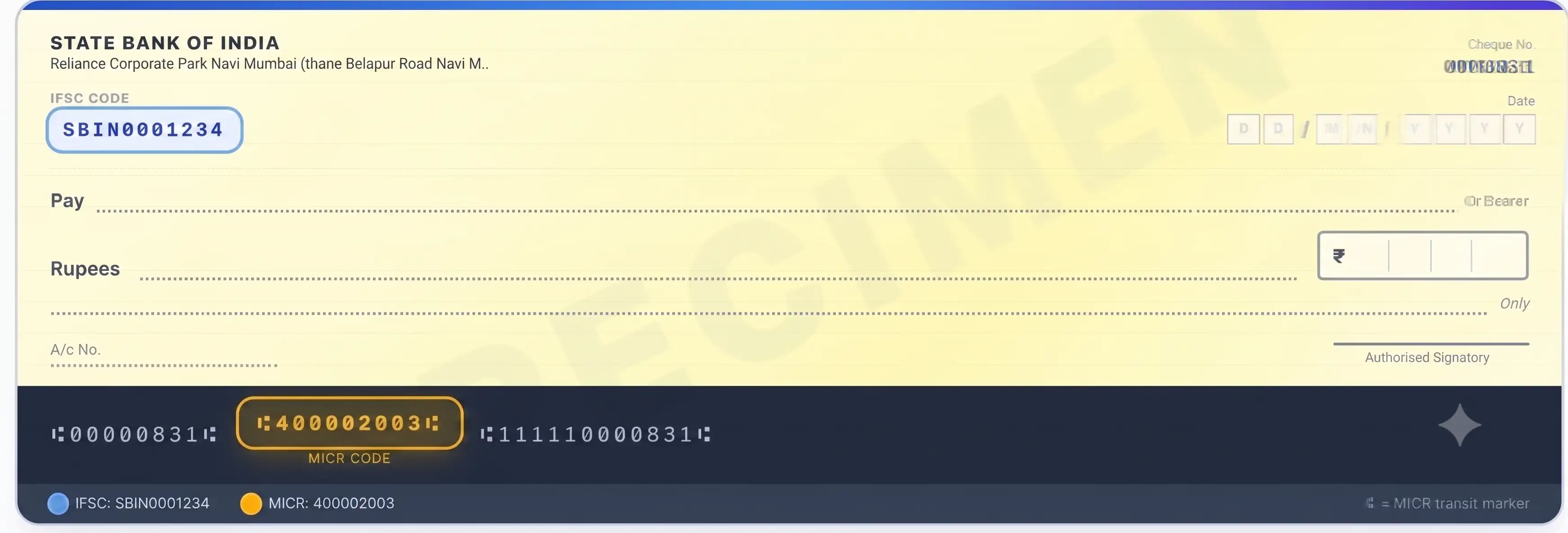
Every cheque issued by an Indian bank carries the IFSC code prominently. Look in two places:
-
Top-right or top-center: Most banks — including SBI, HDFC Bank, Axis Bank, and Canara Bank — print the IFSC code in the header block alongside the branch name and address. It is usually rendered in a slightly smaller typeface, labelled "IFSC:" or "IFSC Code:".
-
The MICR band at the bottom: The bottom 5/8th of a cheque contains the magnetic ink band. While the 9-digit number in this band is your MICR code (not the same as IFSC), some banks print the IFSC above or adjacent to this band as a secondary reference.
Critical note: MICR and IFSC are entirely different identifiers. MICR routes physical cheques through clearing houses. IFSC routes electronic transfers. Never use one in place of the other.
On Your Passbook
Open the first page — the account summary page that was stamped or printed when you opened your account. In addition to your account number, account type, and branch address, this page will list:
- IFSC Code of your home branch
- MICR Code of your home branch
- Occasionally, the branch's SWIFT Code (for NRI/international accounts)
The passbook is the single most authoritative offline reference because its details are printed directly at account opening, drawn from the bank's core banking system.
Swipe left to view full cheque →
Method 2: Net Banking and Mobile Apps — How to Check IFSC Code Digitally
If you prefer not to dig through physical documents, knowing how to check ifsc code through your bank's digital platforms takes under 60 seconds. Here is a bank-specific walkthrough for India's three largest retail banks:
SBI — YONO App and Net Banking
- Open the YONO SBI app (or log into onlinesbi.sbi).
- From the home dashboard, tap your savings/current account card.
- Scroll to "Account Details" — below your account number and branch name, you will find the IFSC code explicitly labelled.
- Alternatively, navigate to Services → Account Statement → View Account Details on the net banking portal for the same information.
HDFC Bank — Mobile Banking App
- Log into the HDFC Bank MobileBanking app.
- On the home screen, select the account you want to check.
- Tap "Account Details" or the ⓘ information icon.
- The branch IFSC code is listed alongside the branch address in the account information panel.
- On netbanking.hdfcbank.com, navigate to Accounts → My Accounts → IFSC Code in the account summary card.
ICICI Bank — iMobile Pay
- Open iMobile Pay and authenticate with your MPIN or biometrics.
- From the main screen, tap "Accounts & Deposits."
- Select your account, then tap "Account Details."
- Your IFSC code appears under the branch details section, with a handy copy-to-clipboard button for immediate use.
Most second-tier banks — including Kotak Mahindra, Punjab National Bank, Bank of Baroda, and IndusInd Bank — follow near-identical navigation paths within their respective apps. The label will always say "IFSC" or "IFSC Code."
The Account Number Dilemma: A Crucial Clarification
This is arguably the most-searched yet least-correctly-answered topic in Indian retail banking. Let us be direct.
How to Find IFSC Code from Account Number — The Truth
You cannot mathematically decode an IFSC code from an account number alone.
This myth persists because people notice that some account numbers contain what looks like a branch identifier. In reality, your bank account number is a customer-profile identifier specific to your relationship with the bank. It encodes information like your customer ID, account type, and sometimes a branch reference — but this encoding is proprietary to each bank's internal system and is not publicly standardized.
The IFSC code, on the other hand, is assigned by the RBI and is entirely separate from account numbering logic. SBI's 17-digit account numbers, HDFC's 14-character numbers, and ICICI's 12-digit format all follow completely different internal schemas that have no mandated relationship to IFSC.
How to Get IFSC Code from Account Number — Two Legitimate Pathways
While you cannot derive it arithmetically, your account number is the key that unlocks the IFSC code through two secure channels:
1. Log Into Your Bank Portal Use your account number (along with your password or OTP) to authenticate on net banking or a mobile app. Once inside, navigate to Account Details as described in Method 2. Your account number is the credential — the IFSC is the information it grants access to.
2. Call Your Bank's Customer Care Provide your account number and complete the identity verification process (usually date of birth + registered mobile OTP). Any bank representative — whether at SBI's 1800-11-2211, HDFC's 1800-202-6161, or ICICI's 1800-1080 — can read out your home branch IFSC code. This is the standard procedure and takes under five minutes.
Method 3: RBI Portal vs. Dedicated Search Tools — How to Find IFSC Code at Scale
The RBI publishes an official master list of all IFSC codes at rbi.org.in. It is accurate, authoritative, and free. It is also an Excel file with 181,000+ rows, no search functionality, and a user experience that has not been updated since roughly 2009.
When you need to how to find ifsc code for a branch you do not bank with — perhaps to add a new payee, verify a vendor's banking details, or cross-check a code someone has given you — a dedicated IFSC directory is dramatically faster:
| Feature | RBI Excel Sheet | Dedicated IFSC Directory |
|---|---|---|
| Search by bank + state | ❌ Manual filter | ✅ Instant dropdown |
| Search by branch name | ❌ No | ✅ Yes |
| Mobile-optimized | ❌ No | ✅ Yes |
| Copy-to-clipboard | ❌ No | ✅ One tap |
| Data currency | Quarterly update | Mirrors RBI data |
A high-quality IFSC search tool indexes the same RBI-sourced data but wraps it in a searchable interface: select bank → select state → select district → select branch. The result — a verified IFSC code, MICR code, and full branch address — appears in under two seconds.
IFSC Index Free Lookup Tool
1.5 lakh+ branches · Instant results · No sign-up
Select your bank, state, district, and branch to retrieve the exact IFSC code — verified against the RBI's official data.
Frequently Asked Questions
Does every bank branch in India have a unique IFSC code?
Yes. Every branch that is part of the RBI's electronic transfer network (NEFT/RTGS/IMPS) has a unique 11-character IFSC code. As of 2026, there are 181,264 active IFSC codes across all scheduled commercial banks, regional rural banks, cooperative banks, and payment banks in India.
Can an IFSC code change over time?
Yes, and this is important. When two banks merge — such as when Vijaya Bank and Dena Bank were absorbed into Bank of Baroda in 2019, or when SBI acquired its associate banks — all affected branches receive new IFSC codes. Old codes are typically valid for a transition period of 12–24 months before being deactivated. Always verify against an up-to-date source before a high-value transfer.
Is it safe to share my IFSC code and account number?
Yes. Providing your IFSC code and account number is the standard, RBI-sanctioned method for receiving money via bank transfer. This information enables credit — incoming transfers — to your account only. To debit your account, the sender would additionally need your internet banking credentials, OTP, or UPI PIN, none of which you share.
What happens if I use the wrong IFSC code?
The payment gateway will either reject the transaction immediately (if the code format is invalid) or route the funds to an incorrect branch (if the code is valid but wrong). In the latter case, the receiving bank is required under RBI guidelines to return the funds within 2 hours for RTGS and by the next settlement cycle for NEFT. Contact your bank's customer care immediately with the UTR number if this occurs.